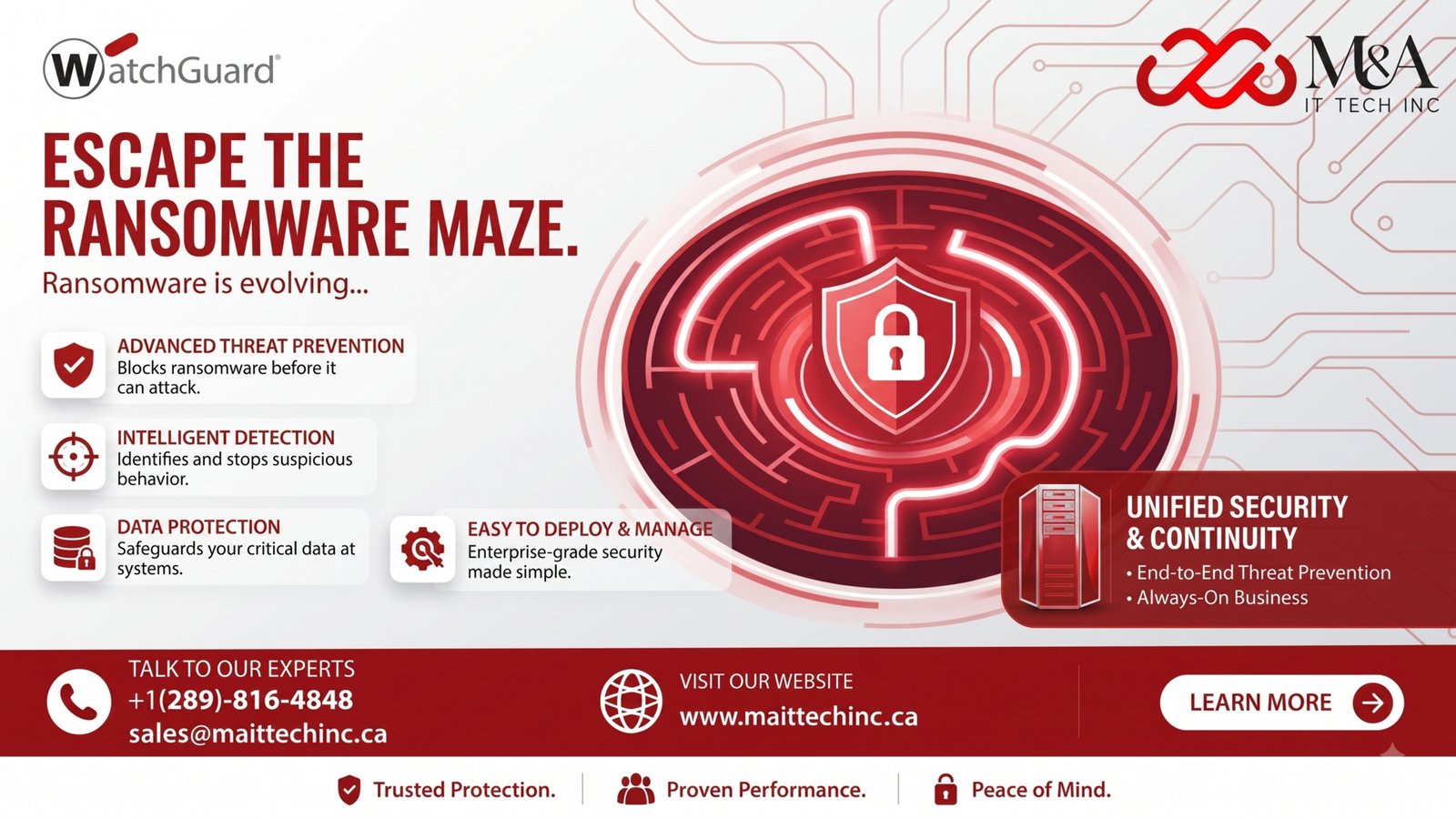
Escaping the Ransomware Maze: How WatchGuard Protects Modern Businesses
Ransomware has quietly become one of the most profitable criminal industries in the world. It no longer just locks up a few files and demands a small fee today’s attacks are engineered to cripple entire organizations, steal sensitive data, and extort victims from multiple angles at once. For businesses of every size, understanding how these attacks unfold and how a layered security platform like WatchGuard defends against them has never been more important.
The Ransomware Problem Is Getting Worse, Not Better
Ransomware attack volume has continued to climb sharply. Fortinet’s FortiGuard Labs 2026 Global Threat Landscape Report identified 7,831 confirmed ransomware victims globally in 2025, a 389% year-over-year jump from roughly 1,600 the year before. IBM’s X-Force Threat Intelligence Index tracked 109 active ransomware groups in 2025, a 49% year-over-year increase, as law enforcement pressure splintered larger operations into smaller ones. What makes the current wave especially dangerous is how entrenched double extortion tactics have become: insurance data from Travelers shows this technique encrypting data and threatening to leak it is now present in the vast majority of ransomware claims. IBM’s Cost of a Data Breach Report puts the average cost of a ransomware or extortion incident at $5.08 million when disclosed by the attacker, several times higher than the median ransom demand itself.
Attackers have also realized they don’t need to steal data that’s valuable to resell they simply need to hold hostage data that’s valuable to the victim. That reframing has pulled smaller and mid-sized organizations, who once assumed they were “too small to be a target,” directly into the crosshairs; Sophos’s 2026 State of Ransomware report, drawn from organizations with as few as 100 employees, shows ransomware is a routine mid-market threat, not just a large-enterprise one.
Ransomware families and tactics also shift quickly. Groups like LockBit, Phobos, and BlackCat established the current playbook, while newer, highly active groups such as Qilin and Akira have gained significant market share more recently. Across variants, the top infection vectors remain consistent: ransomware-as-a-service operations, spear phishing, exploitation of unpatched systems, double extortion schemes, and supply-chain compromises.
Anatomy of a Ransomware Attack
Most ransomware incidents follow a predictable three-stage lifecycle:
- Initial Access Attackers get a foothold through stolen passwords, brute-force attempts, exposed internet-facing services (like RDP or VPNs), unpatched software vulnerabilities, or phishing emails carrying malicious attachments.
- Consolidation and Preparation Once inside, attackers deploy reconnaissance tools (e.g., Nmap, BloodHound), credential-dumping utilities (e.g., Mimikatz), and built-in system tools like PowerShell or WMI to move laterally, escalate privileges, and critically destroy backup copies so the victim can’t simply restore and walk away.
- Impact on Target With defenses disabled and backups destroyed, the attacker exfiltrates sensitive data and encrypts systems, leaving behind a ransom note demanding cryptocurrency payment in exchange for decryption or silence.
Because this entire chain can execute in a matter of minutes, prevention has to happen well before the encryption stage. Waiting until files start locking up is already too late.
Why Traditional Antivirus Isn't Enough
Signature-based antivirus tools are built to catch known threats. Modern ransomware is specifically engineered to evade them using fileless techniques, living-off-the-land tactics that abuse legitimate system tools, and constantly mutating code. A comprehensive defense needs to combine prevention, detection, and response into a single coordinated system rather than relying on one static layer.
How WatchGuard Endpoint Security Stops the Chain
WatchGuard’s flagship endpoint solution, EPDR (Endpoint Protection, Detection and Response), is built around a zero-trust, layered defense model that maps directly onto each stage of the ransomware lifecycle:
- Multi-Factor Authentication (AuthPoint): Since most attacks start with stolen credentials, AuthPoint requires a second proof of identity including phishing-resistant FIDO2 passkeys, push notifications, and biometric options so a stolen password alone isn’t enough to get an attacker in the door.
- RDP Protection & Network Attack Protection: Blocks external RDP connections that have previously failed login attempts and shields against SMB-based lateral movement techniques used by worms like WannaCry.
- Patch Management: Closes the vulnerability gaps that ransomware families have historically exploited (WannaCry, Petya, Locky, and Cerber all relied on unpatched software).
- Zero-Trust Application Service: Every process is continuously classified based on real, dynamic behavior rather than a static signature meaning unknown or unauthorized applications simply aren’t allowed to run.
- Contextual Detections & Anti-Exploit Technology: Identify fileless and malwareless attacks, including malicious macros in Office documents and living-off-the-land abuse of trusted system tools.
- Decoy Files (Honeypots): Planted files act as tripwires the moment ransomware attempts to modify them, the behavioral engine flags and kills the responsible process before mass encryption can begin.
- Anti-Tamper Protection: Prevents attackers from disabling or suspending endpoint protection itself, a favorite tactic of strains like Ryuk.
- Threat Hunting Service: Continuously monitors for indicators of attack (IoAs), catching abnormal behavior at the earliest stages often before any malware payload is even involved.
- Shadow Copy Remediation: Leverages OS-level shadow copies (protected by anti-tampering technology) so files can be restored even after an attack destroys primary backups.
At the network layer, WatchGuard Total Security rounds out the picture with Cloud Sandboxing (APT Blocker) for zero-day threats, AI-powered malware classification (IntelligentAV), DNS filtering to block malicious domains before a connection is even made, and ThreatSync, which correlates signals across network and endpoint telemetry for unified extended detection and response (XDR).
10 Practical Ways to Defend Against Ransomware
Technology alone isn’t a silver bullet good security hygiene matters just as much. WatchGuard recommends:
- Perform frequent, tested backups and keep copies offline and offsite.
- Enforce multi-factor authentication and strong, managed passwords.
- Limit network access with least-privilege and time-based permissions.
- Add XDR capabilities for broader visibility and faster response.
- Patch operating systems and applications early and often.
- Layer anti-phishing protection at both the endpoint and network perimeter.
- Secure remote access disable unused RDP, enforce 2FA and VPN.
- Enable anti-tamper protection to stop attackers disabling your defenses.
- Actively monitor and respond to security alerts, ideally with a zero-trust EDR model.
- Train users regularly on phishing and social engineering risks.
The Bottom Line
Paying a ransom is never a guarantee of recovery decryption keys may not work, and the systems remain compromised regardless. The only sustainable strategy is prevention: closing the gaps attackers rely on before they ever get a foothold. By combining strong identity security, layered endpoint defenses, network-level threat correlation, and disciplined operational hygiene, WatchGuard gives organizations a realistic path to escaping the ransomware maze instead of becoming its next headline.
Shop These WatchGuard Products
Looking to upgrade your Firebox M Series appliance? These WatchGuard expansion modules add extra copper or fiber ports for higher-throughput network connections. Available through M&A IT Tech Inc.:
Ready to Protect Your Business From Ransomware?
Don’t wait for a ransomware attack to find out where your defenses fall short. M&A IT Tech Inc. is a trusted WatchGuard reseller and IT solutions provider, helping businesses across Canada deploy the right mix of endpoint security, multi-factor authentication, and network protection for their environment.
📞 Call us at +1 (289) 816-4848
📧 Email: sales@maittechinc.ca
🌐 Explore our full range of network and security solutions at maittechinc.ca
Get a free consultation and find out which WatchGuard solution EPDR, AuthPoint, or Total Security is the right fit to keep your business out of the ransomware headlines.
Frequently Asked Questions
- What is ransomware, and how does it infect a business network?
Ransomware is malicious software that steals and/or encrypts business data, rendering files and systems unusable until a ransom is paid. It typically enters a network through phishing emails, stolen or brute-forced credentials, unpatched software vulnerabilities, or exposed remote access services like RDP and VPNs.
- Is paying the ransom a safe way to recover my data?
No. Paying does not guarantee your files will be restored or that attackers won’t leak stolen data anyway. Many victims pay and still lose data, face repeat attacks, or discover their systems remain compromised. Prevention and reliable backups are far more effective than relying on attacker cooperation.
- How is WatchGuard different from traditional antivirus software?
Traditional antivirus relies mainly on known threat signatures, which modern ransomware is designed to evade. WatchGuard EPDR combines next-gen antivirus with EDR, zero-trust application classification, anti-exploit technology, and 24/7 threat hunting layering multiple detection methods so attacks are caught even when they don’t match a known signature.
- Can small and mid-sized businesses (SMBs) really be targeted by ransomware?
Yes. Attackers no longer need to “resell” your data they simply hold it hostage because it’s valuable to you. This makes any business with business-critical data a potential target, regardless of size or industry.
- What’s the single most important step to prevent ransomware?
There isn’t one silver bullet, but enabling multi-factor authentication (MFA) and keeping systems patched address the two most common entry points stolen credentials and unpatched vulnerabilities while regular offline backups ensure you have a fallback if an attack still gets through.
- Does M&A IT Tech Inc. help set up WatchGuard solutions for my business?
Yes. As a WatchGuard reseller, M&A IT Tech Inc. can help assess your current security posture and deploy the right combination of WatchGuard Endpoint Security, AuthPoint MFA, and Total Security network protection tailored to your business. Contact our team to get started.